Everyday Guide
A practical guide to food, rhythm, regulation, patterns, priorities and everyday practice.
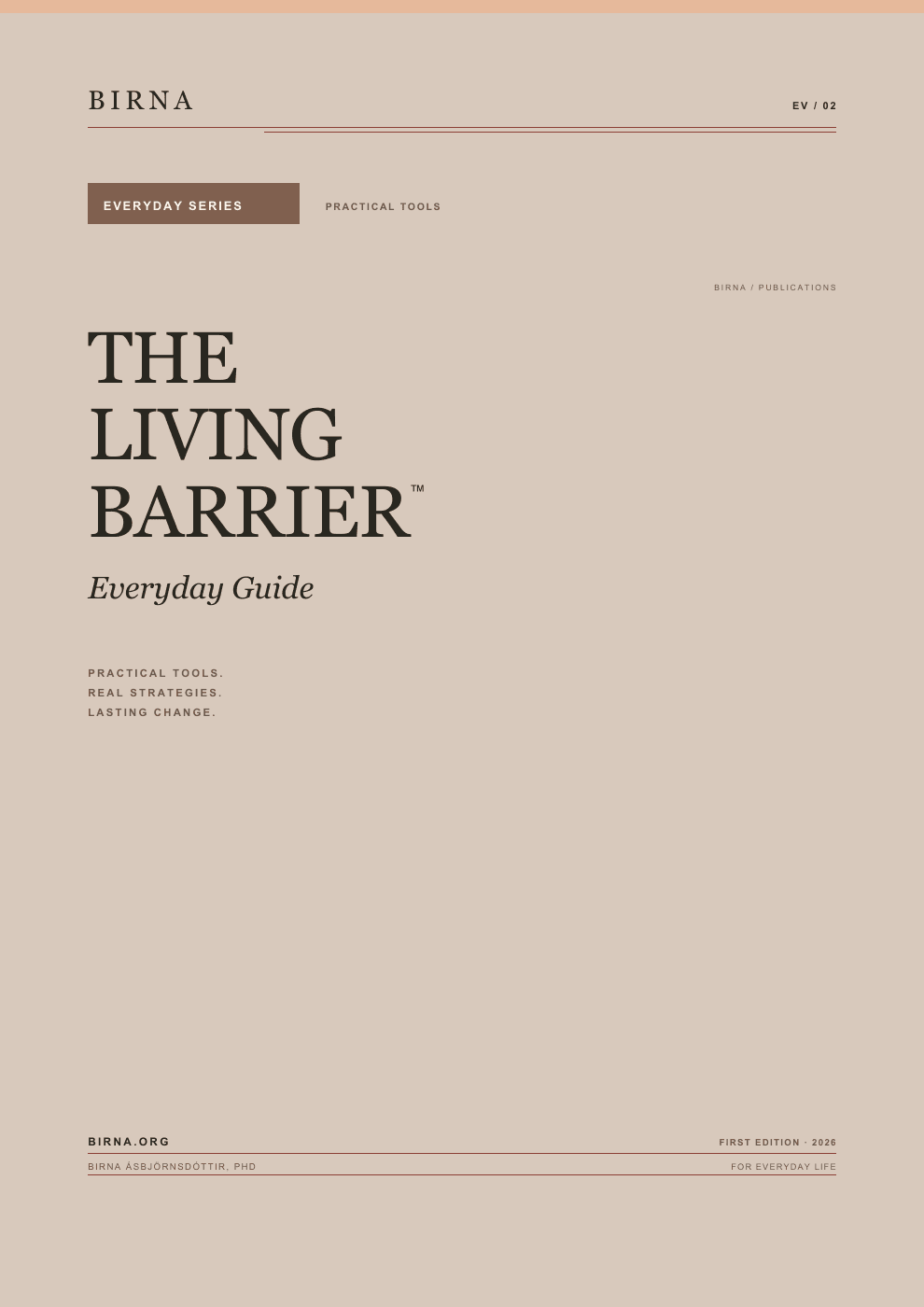
Available now · €29
A working sequence
From information to a useful next step.
More information does not always make the next decision clearer. The Guide offers a way to notice patterns in context and decide what deserves attention—without another rigid protocol.
- 01Notice
- 02Contextualise
- 03Choose
- 04Try
- 05Review
01 · Orientation
See your living system.
The Living System Map places your context at the centre. Barrier function, immune sensing, the microbial world, metabolism, gut–brain communication and everyday context are considered together, not as isolated parts.
Notice relationships; do not turn one component into a diagnosis. A relationship is useful context, not automatically a cause.
02 · Baseline
Find your baseline.
A baseline is a description, not a score. The Guide’s Living Barrier Check-in belongs to this reflective starting point: ordinary patterns and surrounding context matter before a change can be interpreted.
Stop self-observation when symptoms are severe, persistent, worsening, unexplained or materially affect normal functioning.
03 · Food & context
Build diversity without turning food into another rule.
Diversity rather than perfection. Adequacy rather than unnecessary restriction. Patterns over time rather than judgement of isolated foods.
Pattern
The wider view across ordinary days.
Adequacy
Nourishment matters alongside variety.
Tolerance
Context and individual differences matter.
The Guide includes a Weekly Food Pattern and Diversity Map. They keep variety in view without making it a universal plant-count target or a reason for unnecessary restriction.
Observation with boundaries
Understand more.
Monitor less.
Useful observation is brief, neutral and connected to a question. Noise and ordinary variation are expected. Things that occur together are not automatically causally connected.
Stop if tracking increases anxiety, compulsive monitoring or unnecessary food restriction. Self-observation should never delay appropriate professional assessment.
04 · Evidence literacy
Question microbiome claims.
A confident microbiome promise can hide important differences in evidence, population and outcome. The Guide’s Microbiome Claim Check provides a way to examine a claim before deciding what weight to give it.
No food, supplement or test can be assumed to reset, balance or diagnose a personal microbiome.
05–08 · Everyday context
Rhythm, stress, movement and disruption.
Rhythm
Daily rhythms offer context, not an ideal schedule.
Stress & regulation
Experiences may occur together without revealing a single cause.
Movement & recovery
Movement belongs within whole-person context, not a predictable microbiome formula.
Disruption
Illness, medicines, travel and changing routines can alter the picture without implying inevitable damage.
Never stop or change prescribed medication on the basis of this Guide. Questions about medicines, significant effects or deterioration belong with an appropriate qualified professional.
09 · Practical tool
Choose your next useful step.
The Guide helps you move from diffuse advice to one realistic, proportionate next step. The complete tool supports the choice and its review without turning ordinary variation into a problem to solve.
11 · Implementation
Your next 30 days.
- Week 1
Notice
- Week 2
Choose
- Week 3
Apply
- Week 4
Review
The goal is not perfect control.
It is better understanding.
Inside the Guide
What you actually get.
Your Living System Map
An orientation to interacting parts and everyday context.
Living Barrier Check-in
A reflective part of the Guide’s existing baseline framework.
My Next Useful Step
A structured way to move from observation toward a proportionate choice.
Microbiome Claim Check
A tool for examining the promises behind microbiome advice.
Reusable worksheets
Space to return to patterns and context without constant tracking.
Selected evidence
Sources and limits behind the Guide’s scientific framing.
Who this is for
Structure without another protocol.
For readers surrounded by gut-health advice who want to understand the living system more clearly, notice patterns without over-monitoring, and choose realistic everyday actions without treating ordinary variation as pathology.
What it supports
- Food and lifestyle literacy in relation to the living system.
- Prioritisation instead of an undifferentiated recommendation list.
- Individual context, adequate nourishment and gradual adaptation.
- Patterns over time rather than judgment of isolated foods or days.
What it does not do
- Diagnose, treat or promise a health outcome.
- Prescribe a perfect diet or microbiome.
- Encourage medication changes, restrictive protocols or self-treatment.
- Replace appropriate professional assessment.